
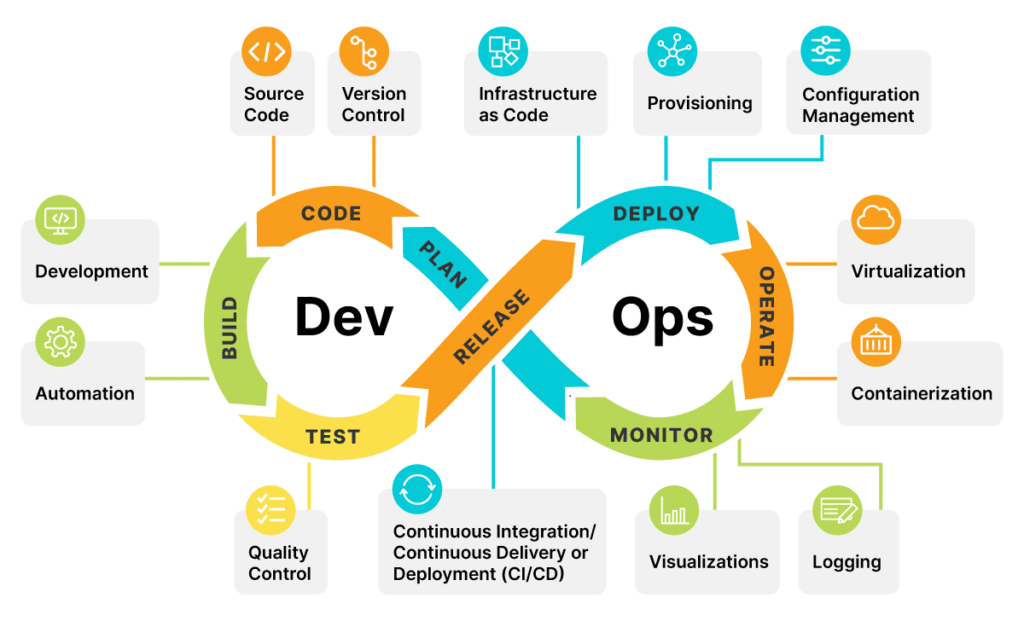
Modern DevOps: Cloud Infrastructure, Automation, and Platform Engineering
Build the practical skills to design, automate, secure, and operate modern cloud infrastructure. This course connects DevOps culture and systems fundamentals with hands-on work in Linux, Python, Shell, version control, containers, and cloud platforms. Progress from infrastructure and delivery automation to monitoring, DevSecOps, and platform engineering. In a final project, bring these practices together to deliver and operate a secure, observable cloud-based service.
Last Cohort Discount
Offer ends in 15 days
Or pay in installments at checkout.
This course includes
Course Curriculum
7 modules · 45 lessons1DevOps Culture, Linux Operations, and Network Fundamentals7 lessons
Explore DevOps principles, collaborative operations, Linux administration, shell scripting, and core networking and security concepts. Apply these foundations to diagnose system and connectivity issues and manage servers confidently.
Set Up a Linux Operations Lab
Configure a Linux virtual machine with OpenSSH, Git, a shell environment, and diagnostic utilities for hands-on operations work.
Apply DevOps Culture to Operational Work
Map a software delivery workflow to shared ownership, feedback loops, and blameless incident practices.
Administer Linux Users, Processes, and Services
Diagnose and resolve a service failure using systemd, permissions, process tools, and system logs.
Automate Repeatable Operations with Shell Scripts
Write a robust Bash script that validates prerequisites, performs a routine server task, and reports actionable errors.
Build a Linux Server Operations Toolkit
Create and document a reusable toolkit of Bash scripts for health checks, log inspection, and service recovery.
Diagnose Network Paths and Apply Security Controls
Trace a connectivity failure with standard Linux network tools and verify the effects of DNS, routing, firewall, and SSH configuration.
Capstone: Diagnose and Recover a Misconfigured Server
Restore a deliberately misconfigured Linux server by combining incident practices, system administration, shell automation, and network diagnostics.
2Version Control and Python Infrastructure Automation6 lessons
Use Git-based workflows and Python to automate repeatable operational tasks, manage configuration, and validate infrastructure changes. Build maintainable scripts and collaborate through reviewable, traceable changes.
Set Up a Python and Git Infrastructure Automation Workspace
Configure a reproducible development environment with Git, Python, virtual environments, pytest, pre-commit, and Terraform.
Manage Infrastructure Automation Through Reviewable Git Workflows
Implement a feature-branch workflow with focused commits, pull requests, and traceable change records.
Build Safe, Configuration-Driven Python Automation
Create an idempotent Python CLI that reads validated configuration, supports dry runs, and logs operational outcomes.
Project: Validate Terraform Plan Changes with Python
Build and test a Python tool that parses Terraform plan JSON and flags infrastructure changes that violate defined policies.
Automate Quality Gates for Infrastructure Changes
Configure GitHub Actions to run Python tests, linting, pre-commit checks, and Terraform validation on pull requests.
Capstone: Deliver a Reviewed Cloud Operations Automation Tool
Deliver a tested, configuration-driven Python automation tool with safe execution controls and a complete Git-based review workflow.
3Cloud Infrastructure Design on AWS and Google Cloud6 lessons
Learn cloud architecture and resource management across AWS and Google Cloud, including identity, networking, compute, storage, and cost considerations. Provision and operate infrastructure using documented cloud services and secure operational practices.
Set Up AWS, Google Cloud, and Terraform Workflows
Configure AWS CLI, Google Cloud CLI, Terraform, and secure authentication for repeatable infrastructure work in both clouds.
Design Cross-Cloud Identity and Access Controls
Map workload and operator access requirements to least-privilege IAM roles and policies in AWS and Google Cloud.
Plan Secure Cloud Network Architectures
Design AWS and Google Cloud network topologies with segmented subnets, controlled ingress and egress, and private service access.
Select Compute and Storage for Workloads
Choose equivalent compute and storage services across AWS and Google Cloud using workload, resilience, security, and cost requirements.
Project: Provision a Cross-Cloud Infrastructure Baseline
Build reusable Terraform configurations that provision a secure network and workload-ready identity baseline in AWS and Google Cloud.
Capstone: Deploy and Operate a Resilient Cross-Cloud Workload
Extend the infrastructure baseline to deploy a sample workload with protected storage, operational monitoring, documented recovery procedures, and cost controls in both clouds.
4Containerization and Reliable Service Deployment6 lessons
Package applications and their dependencies with Docker, then explore Kubernetes concepts for deploying and managing containerized services. Configure repeatable deployments and apply service health, scaling, and security practices.
Set Up a Local Container and Kubernetes Development Environment
Configure Docker, kubectl, and kind to build images and run a local Kubernetes cluster.
Build Reproducible, Production-Ready Docker Images
Create a multi-stage Dockerfile that produces a small, non-root image for an application.
Deploy an Application with Kubernetes Workloads and Services
Deploy a containerized application using Kubernetes Deployments, Services, ConfigMaps, and health probes.
Project: Containerize and Deploy a Service Locally
Build and deploy a working application to kind using a Docker image and version-controlled Kubernetes manifests.
Improve Service Reliability, Scaling, and Security
Configure resource requests and limits, autoscaling, secure configuration, and rolling-update safeguards for a Kubernetes workload.
Capstone: Deliver a Reliable Kubernetes Service
Implement a repeatable deployment for a containerized service with health checks, scaling, and security controls, then demonstrate its behavior during an update.
5Continuous Integration and Continuous Delivery Pipelines7 lessons
Design CI/CD workflows that build, test, scan, and deploy software through controlled environments. Integrate version control, containers, and cloud infrastructure to make releases repeatable and easier to recover.
Set Up a CI/CD Repository and Toolchain
Configure a sample application repository with GitHub Actions, Docker, and the cloud credentials needed for pipeline execution.
Build Reliable CI Workflows with Dependency Caching
Create a GitHub Actions workflow that validates pull requests with reproducible builds and automated tests.
Add Code Quality, Dependency, and Container Security Scans
Integrate automated quality and security checks that block a build when configured risk thresholds are exceeded.
Package and Publish Immutable Container Artifacts
Build and publish a versioned container image whose digest can be traced to its source commit.
Project: Implement an End-to-End CI Pipeline
Deliver a working pull-request pipeline that tests, scans, builds, and publishes the sample application.
Deploy Through Controlled Environments with Recovery Paths
Configure staged cloud deployments with environment approvals, infrastructure changes, health checks, and rollback procedures.
Capstone Project: Deliver a Production-Ready Release Pipeline
Build and demonstrate a complete pipeline that promotes an immutable application artifact through controlled cloud environments and recovers from a failed deployment.
6Observability, DevSecOps, and Platform Engineering7 lessons
Use logs, metrics, traces, and alerting to understand service health and respond to operational incidents. Incorporate security checks into delivery workflows and apply platform engineering principles to provide consistent self-service capabilities for development teams.
Set Up a Kubernetes Observability and Delivery Toolchain
Deploy OpenTelemetry Collector, Prometheus, Grafana, Loki, Tempo, and a sample service to a Kubernetes environment.
Instrument Services with OpenTelemetry
Instrument a service to emit correlated traces, metrics, and structured logs through OpenTelemetry.
Define SLOs, Dashboards, and Actionable Alerts
Create Grafana dashboards and alert rules that measure service-level objectives and link alerts to response runbooks.
Project: Build and Investigate an Observable Service
Deploy an instrumented service with dashboards and alerts, then diagnose a deliberately introduced failure using its telemetry.
Integrate Security Controls into CI/CD
Configure a GitHub Actions pipeline to run Semgrep, Trivy, and software bill of materials generation with policy-based delivery gates.
Build a Self-Service Golden Path
Create a Backstage software template that provisions a service repository with standardized deployment, security, and observability configurations.
Capstone: Deliver a Secure, Observable Platform Service
Deliver a service through the Backstage golden path and demonstrate its security controls, operational telemetry, and response to an injected incident.
7End-to-End Cloud Service Operations Capstone6 lessons
Design, deploy, and operate a cloud-hosted service that combines automation, containerization, CI/CD, security controls, and observability. Present the architecture, operational runbooks, and evidence that the service can be maintained and improved.
Provision the DevOps Toolchain and Cloud Sandbox
Configure a version-controlled workspace, cloud account, CLI, Terraform, container tooling, and Kubernetes access for the capstone environment.
Design the Service Architecture and Delivery Workflow
Produce an architecture diagram and repository plan that define the service, cloud components, deployment flow, trust boundaries, and operational requirements.
Build Repeatable Cloud Infrastructure with Terraform
Implement reusable Terraform configuration that provisions the service network, runtime platform, identity resources, and environment-specific settings.
Automate Secure Container Builds and CI/CD
Create a CI/CD pipeline that tests and scans the application, builds and signs its container image, and deploys it using least-privilege credentials.
Project: Deploy the Cloud Service and Instrument Its Runtime
Deploy the containerized service to the provisioned cloud environment and configure health checks, logs, metrics, traces, and actionable alerts.
Capstone: Operate, Explain, and Improve the Cloud Service
Demonstrate a safe deployment and recovery workflow, present the architecture and runbooks, and use operational evidence to propose a measurable improvement.
Course Details
- Level
- Experienced
- Duration
- 16 Weeks
- Modules
- 7
- Lectures
- 45
- Language
- English
- Certificate
- Included
- Last Updated
- 25 Oct 2026
What You Get
- Expert-led lectures
- AI-powered learning assistant
- Live classes with instructors
- Hands-on projects & assignments
- Certificate of completion
- 3 months free Community membership